Showing posts with label language trends. Show all posts

Thursday, May 21, 2009

A Coinage in My Head That Just Won't Mint

Two weeks before the deadline for my new book, I keep hearing in my head a term I think made up: “I hit the decimal point.”

Its bones are kind of like “it shit the bed” or “he screwed the pooch,” just without the yuck factor.

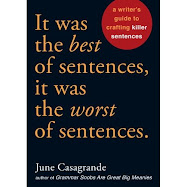
The idea is that I was trucking along writing this book (it's about sentence writing), working at a fine clip, when suddenly I noticed that the the words "the end" seemed to be moving further away. With every hour I put into the project, completion was set back an hour.

I remembered I needed to further explain something about adverbs. I realized that I'd stumbled on a disparity in the linguistics world that I had to find a way to deal with. (Experts, it seems, use the term "participial phrase" for the same thing that others call a "participial clause." Geoff Pullum from Language Log was kind enough to write me back and explain that, basically, it's a matter of interpretation. Just he explained it better than that.) I realized that I needed a chapter on quotation attributions (something that hit me around the jillionth time I edited a certain writer's use of "enthused" as quotation attribution. "Our peppermint facials are very soothing," Jones enthused. Yuck.).

Anyway, "I hit the decimal point" seemed the only way to explain how I seemed to be getting infinitesimally closer to finishing -- but never done.

I've always wondered about how phrases get coined. I've always found it fascinating how, one day I hear a co-worker say, "You rock," then suddenly I'm hearing it everywhere I turn -- for twelve years and counting.

But, today, I think I've unlocked one secret of phrase coinage: In order to catch on, it has to be good.

Also, I hope I've unlocked the secret of how to apologize for being an AWOL blogger without resorting to the tedious blog opener "Sorry I haven't blogged in so long"). The secret: Bury the apology under a long story about how busy I've been.

(Sorry 'bout that.)

Bookmark and Share


Tuesday, February 17, 2009

Wonderings and Googlings (Wherein I wonder about words, then I Google them)

"I friended him." = 940 hits
"I befriended him." = 628 hits

A story this morning on NPR about Facebook got me wondering whether "friend" as a transitive verb was poised to replace the word that has long done its job: "befriend."

Looks like it is.

Bookmark and Share


Monday, January 26, 2009

Wonderings and Googlings (Wherein I wonder about words, then I Google them)


snicker = 1,480,000 hits
snigger = 409,000 hits

Dictionaries treat "snigger" as a secondary spelling of "snicker." I was just curious how secondary it was. It's more popular than I would have guessed.

(To control for the candy bar, the actual search terms were "snicker -snickers" and "snigger -sniggers. [Who knew that I would ever find occasion to use the term "control for the candy bar"?])

Bookmark and Share

Wednesday, December 17, 2008

Prescient, Googling Li'l Ol' Me


Five days after I analyzed language trends to demonstrate the declining cultural impact of cocaine, the Los Angeles Times yesterday reported a decline in cocaine on U.S. streets. Yeah, I'm that good. So I'd also like to use my rare insights to predict that President Bush will be out of the White House by February and that Tom Cruise will fail to convince the world he's not a weenie.


Bookmark and Share

Thursday, December 11, 2008

Wonderings and Pre-Google Googlings (Wherein I wonder about word issues Google can't help me with, then hack into a source that can)


I heard a new old expression the other day. The teacher of the economics class I'm watching via online video said that if you can identify an undervalued stock, you can get rich "in a cocaine heartbeat."

Now quick: Guess whether the instructor is in his late-30s, his early-50s, or his mid-60s.

That's right, late-thirtysomethings don't speak of cocaine. They're all "Heroin this and Kurt Cobain that." Mid-60s types, on the other hand, are all "Reefer this and Timothy Leary that."

This level of cocaine consciousness can only come from someone who spent some formative social years in the 1980s -- a time when certain types wore on chains around their necks things called "coke spoons." A time when you'd occasionally run across a man who kept one pinky nail much longer than all his other fingernails. A time when twenty- and thirtysomethings were all "nose candy this and Crockett and Tubbs that."

So, wondering how this cultural emphasis was reflected in the language, I searched the Los Angeles Times archives for the word "cocaine" over two different time spans.

Jan. 1 to Dec. 31, 2007 = 399 hits
Jan. 1 to Dec. 31, 1986 = 1, 724 hits


I rest my superfreaking, white-loafer-wearing, party like it's 1999 case.


Bookmark and Share

Thursday, September 11, 2008

When English in Rome ... (English words the Italians have incorporated -- and hate themselves for it)

'Weekend', 'welfare,' 'OK', 'briefing', 'mission', 'know how', 'shampoo' and 'cool'.

According to a Telegraph.co.uk article, these are a few of the English words that Italians say are stinking up their language.

Yeah, WE'RE the contagion. I'll try to remember that every 20 minutes when I have to listen to the term "venti latte macchiato con panna."


Bookmark and Share

Friday, August 22, 2008

Wonderings and Googlings (Wherein I wonder about words, then I Google them)


Here are some sample hits from a search for the word atrocious.
The atrocious sequel to Are We There Yet?

We've been keeping tabs on the Associated Press's atrocious campaign
coverage this year.

$100 million private-equity buyout boosts (are) atrocious

Do you remember the atrocious and disappointing OECD report on
counterfeiting?


And here are some sample hits for this adjective's noun form, atrocity(ies).
Conditions of atrocity: The crimes at Abu Ghraib are a direct expression of
the kind of war we are waging in Iraq.

In the first months after 9/11, the administration's ruthless exploitation
of the atrocity was a choice, not a necessity.

All varieties of atrocity: battle deaths, civilian casualties of war,
democide, famine caused by the economic disruption.


Other hits for atrocity/atrocities referenced Nuremberg, the Nanjing Massacre, and "Bosnian Muslim atrocities in Srebrenica."

Okay, so now that I've thoroughly bummed you out, I hope you don't mind me pondering the question: How did these two words -- really the same word as different parts of speech -- come to have such very different connotations?

Atrocity, it seems, is used to mean slaughter and bloodshed and torture, while atrocious is often used to ridicule bad sitcoms, bad hair days, and other non-brutal bad choices.

Why? I don't know. But I have a theory. It's a conspiracy theory pointing to a 6-foot-tall English-speaking mouse. A tyrant whose atrocities include forcing innocent children to wear plastic ears and those "Escape from Witch Mountain" movies of the '70s.

My evidence: "Supercalifragilisticexpialidocious. Even though the sound of it is something quite atrocious. ..."

Yes, methinks mesmells Mickey brand sanitizer.

Bookmark and Share


Share

Bookmark and Share