Friday, July 16, 2010

The ABCs of Editing: Always read at least the first sentence

Granny submitted this boo-boo she found here on ABCNews online.

President Obama took on House GOP Leader John Boehner’s call for repealing financial reform before it’s signed yesterday.

Never thought I'd see a boo-boo that made me long for a "t'were." I wonder if this was an editor-inserted error. (They happen. Take it from an editor who's inserted her fair share.)

Bookmark and Share

Thursday, July 15, 2010

Copy Editing Conundrum du Jour

I'm still not sure what to make of this sentence I came across in my copy-editing work today:

Guests are given glowsticks to guide their way through the already freaky figures and dioramas—a gauntlet that’s pretty scary to run even with the lights on.

It's weird enough that it seems to be based on a metaphor mixing "run the gamut" (range, scale) and "throw down the gauntlet" (glove). But "a gauntlet that's scary to run"?

I changed it to "a course that's pretty scary to run." But it'll be a while before I'm confident about it ...

Bookmark and Share

Tuesday, July 13, 2010

Call Me King Christie Dickens

I just learned of a website that analyzes a sample of your writing to tell you which famous writer you write like. Supposedly it analyzes "your word choice and writing style" to make the comparison.

I have no idea how much effort the creators put into making it scientific, but it's definitely fun. A chapter from my last book in which I wax philosophical about pudding shakers was compared to the work of Agatha Christie. A sappy column I wrote after Vonnegut died scored me a Stephen King comparison. And two paragraphs from my brand-new book (which I just got in the mail today!) was written in the style of Charles Dickens.

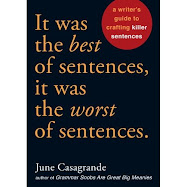
But here's the funny thing: The book is called "It Was the Best of Sentences, It Was the Worst of Sentences" -- a play on Dickens! And, no, the excerpt did not include those words or any other Dickens stuff. Spooky.

Here's the site: http://iwl.me/


Bookmark and Share

Sunday, July 11, 2010

More Parsing Larsson: Verb Inventory

After yesterday’s post about Stieg Larsson, I got an itch to compare his verbs to some other writers’. Not that verbs are the biggest problem with Larsson’s writing. Far from it. Still, I was curious. So here is an inventory of verbs from a page of Larsson’s “The Girl Who Played with Fire,” a page of Cormac McCarthy’s “The Road,” and a page of Stephen King’s “Just After Sunset.”

I list these verbs in their base forms -- i.e. “had been” and “were” are listed as “be.” Verbs forming independent clauses are in all caps. Verbs forming subordinate clauses are lowercase. Participial modifiers are not counted as verbs.

Larsson, page 414 -- 18 sentences:
1. BE
2. BE
3. RECALL, HAVE, be
4. BE
5. UNDERSTAND
6. BE, FIND, find
7. BE, gnaw
8. NOTICE, take, keep
9. BE, BE, summarize
10. HAVE, BE, clear out, throw
11. THROW
12. BE, FIND
13. SEE, remove, deal with
14. SPEND, MISS, COME, HAVE
15. FIND, contain
16. GO, try, find
17. BE
18. DISCOVER, GO, USE

McCarthy, page 136 -- 15 sentences
1. bend, see, FEAR, be, put
2. GO, CROSS
3. SET, TAKE, PUNCH, PUNCH, DRAIN
4. PULL, POUR
5. TWIST, MAKE, POUR, PUT, SHAKE
6. POUR, TAKE, STUFF
7. TAKE, GET, STRIKE
8. TRY, STOP, POUR
9. FLARE, say
10. NOD
11. RAKE, BLOOM
12. REACH, BLOW, HAND
13. SAY
14. TAKE
15. DO

King, page 61– 27 complete sentences
1. HOLD, LOOK
2. LOOK
3. cut, SAY
4. LOOK, CUT
5. CUT
6. TRY, scramble, go, thump
7. PIVOT, BE
8. SEIZE
9. DANGLE
10. GET, TURN
11. WAIT
12. BRING, WANT, MAKE
13. REMEMBER, choke up
14. BE
15. BE
16. BE, be, SOUND, slacken
17. HAPPEN, BEGIN
18. STARE
19. STARE
20. do, SAY, REACH, take
21. SAY, SWING
22. HAMMER
23. BURST, snap
24. RUN, PATTER
25. stop, SAY
26. LOOK
17. SAY, BRING

25% (ten) of Larsson’s verbs are “be.” Just over 25% (eleven) are nonphysical or mental actions like “recall, “understand,” “summarize,” “discover” and “find.”

2-1/2% (one) of McCarthy’s verbs are “be” and 2-1/2% convey a state of mind (“fear.”)

10% (five) of King’s verbs are “be” and most of the rest are actions.

The process I used to choose these pages probably wasn’t fair. I started with a Larsson page I had already noted as bad then flipped through McCarthy and King for pages that looked about as dense with narrative as the Larsson page (that is, pages that didn’t have much dialogue). Still, I bet that a fair and complete accounting of the verbs in all three books would show similar -- if not quite as marked -- tendencies. That is, McCarthy and King rely more on action verbs while Larsson’s work relies more on verbs that convey being, seeming, or thinking.

That’s partly why I prefer reading McCarthy and King.

Larsson structures a lot of his sentences like this:

“The reason for her visit to the crime scene was to get two pieces of information” and “Second was an inconsistency that kept gnawing at her.” (p. 414)

Notice how, in both, he hangs the main clause on “was” and crams the more interesting stuff into less-prominent parts of the sentence. Imagine he had written them:

“She visited the crime scene to find two pieces of information.”
and
“An inconsistency kept gnawing at her.”

See how the noun “visit” can be made into an action? See how “gnaw” can be made the main action in the sentence instead of just part of a relative clause in a sentence whose main verb is the ho-hum “was”?

I think there’s a lesson in here …

Bookmark and Share

Saturday, July 10, 2010

Parsing Larsson

I'm reading Stieg Larsson's "The Girl Who Played with Fire," though I don't know why. It's the second in a trilogy, after "The Girl with the Dragon Tattoo."

The prose in "Dragon" was pretty bad. But the story was fast-paced enough to distract me from the writing. Not so with "Fire." As the story drags on, I've started noticing sentences and passages I want to fix. (It's a copy editor thing. A disease, really.) I started dog-earing examples of problem sentences and paragraphs, figuring I'd analyze them here. But soon, it seemed that every other page was dog-eared with examples too bad to pass up. And I could feel my chest tightening: It's too much. The writing's too convoluted. I can't possibly fix all this. But I can't just let it go, either.

So, in the interest of maintaining healthy blood pressure, I decided that I didn't have to fix all Stieg's problem passages. I could just share some here (tinkering only if it didn't seriously affect my heart rate). So here's an example of Stieg prose (which is also an example of how often huge sales success goes hand in hand with bad writing).

Larsson wrote in Swedish, was translated into English, and then the manuscript presumably passed through the hands of an editor and copy editor. I'm not sure where the blame goes. That said, here's the passage from "The Girl Who Played with Fire."

Salander soon discovered that the person who had leaked the information to the media was Ekstrom himself. This was evident from an email in which he answered follow-up questions about both Salander's psychiatric report and the connection between her and Miriam Wu.

The third significant piece of information was the insight that Bublanski's team did not have a single lead as to where they should look for Salander. She read with interest a report on what measures had been taken and which addresses had been put under sporadic surveillance.


Note how the pivotal verb in three out of four of those sentences is "was." Here's one way that, I suspect, a lot of writers might have written it:

Salander skimmed Ekstrom's emails until she saw one with the subject line "Re: Psych report, Wu connection," addressed to a reporter at a local paper. She opened it. "No," the first line read, "Salander's doctors never used the word 'sociopath' in the report. But they did consider her violent. Re your other question: Miriam Wu admitted she and Salander played 'sex games,' as she called them."

So Ekstrom was the rotten son of a bitch who blabbed to the media.

Salander also found on Ekstrom's computer a list of the places police had been staking out to find her: her old apartment, Miriam's place, Mikhael's cabin. The condo wasn't on the list. They had no clue where she was hiding. Good.


Oy.

Bookmark and Share

Friday, July 9, 2010

NY Times' Sassy Apostrophes


I'll never stop marveling at NY Times' use of apostrophes to form plurals of initialisms. It's a valid choice. I just don't get the why.


Bookmark and Share

Friday, June 25, 2010

Copy Edit du Jour

Two major aspects of the infrastructure revitalization will include revamping education and healthcare systems.


Changed to:

The education and healthcare systems will be revamped.


In the last couple years, I've come to despise structures that say an "aspect" of something is something else: "One fun aspect of the day camp is getting to catch your own fish."

Why not just make the main clause a simple human subject+real action structure? "Kids get to catch their own fish."

Bookmark and Share

Share

Bookmark and Share