Showing posts with label adverbs. Show all posts

Wednesday, October 26, 2011

Copy Edit du Jour

What's more -- aside from a specialized curriculum -- private schools are notoriously known for their smaller classrooms.

Changed to:

Private schools are known for their smaller class sizes.

(Other bad choices aside, I can't BELIEVE the writer used "notoriously known" -- and for something positive, no less. That's the kind of thing I might make up as a ridiculous example of a bad adverb/flabby writing.)


Bookmark and Share

Tuesday, July 27, 2010

My New Book's Out Today!

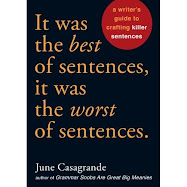
It's called It Was the Best of Sentences, It Was the Worst of Sentences.

It teaches how to improve writing at the sentence level. I based it largely on the writing problems I see in my copy editing work. It talks about upside-down subordination, passives, weak verb choices, weak noun choices, how to pare down flabby prose, how adverbs can backfire on a writer, and more issues that make good writing go bad.

I also use real-life examples of badly written sentences (many of them by professionals) and show how to break them down into parts and rebuild them better.

Here are links on Powell's, Barnes & Noble, Amazon, Borders, and IndieBound.

It Was the Best of Sentences scored back-cover endorsements from literary agent and author extraordinaire Donald Maass (author of The Fire in Fiction), Grammar Girl Mignon Fogarty (author of Grammar Girl's Quick and Dirty Tips for Better Writing), and Elizabeth Little (author of Biting the Wax Tadpole, which, by the way, is a fascinating read for anyone interested in foreign languages).

I really hope It Was the Best of Sentences will help some struggling writers become great writers!
Bookmark and Share

Wednesday, February 3, 2010

'Supposably' Is In the Dictionary

Merriam-Webster says that the adverb form of "supposed" is indeed "supposedly," but the adverb form of "supposable" is "supposably."

Webster's New World is a little vaguer, noting "supposably" only as a "related form" of supposed. However, because WNW has a separate listing for "supposedly" and none for "supposably," there's no doubt which form they prefer.

So, what, exactly is the difference between the adverb form of "supposable" and the adverb form of "supposed"? In their adjective forms, they're clearly different. But as sentence adverbs, the distinction blurs.

I'm going to have to think on this one for a long, long time (after I stop retching, of course). Until then, I'll file this under "things I should have looked up a long time ago."
Bookmark and Share


Thursday, October 1, 2009

From the 'How Not to Do It' File ...

Recently, a friend was digging around in a bookstore and found this passage in an old novelization (a paperback based on a movie as opposed to a movie based on a book).

“His gaze darted around nervously, as if apprehensive that somehow, in some insane fashion, someone would suddenly manage to pop out of hiding and surprise him.”

My friend did not tell me the writer's name. But she did mention that, despite this dazzlng prose, she "suddenly managed" to put the book down.

Bookmark and Share

Wednesday, February 18, 2009

Words I'm Looking Up (One in an occasional, cleverly named series on words I'm looking up)

each


Open up an Associated Press Stylebook to the letter E and the very first entry you see is "each. Takes a singular verb." (At least, it's the first entry in the 1992 version I happen to have handy.)

So when we copy editors think of the word "each," we think of matters such as: There are 50 units, and each has (not have) stunning views.

The problem is that this only applies to "each" the pronoun. But each has other forms:

The college of engineering, college of business, and college of arts and letters each require department approval for admission.

If you're thinking like a copy editor (or at least a copy editor on autopilot), you'll hesitate at that each, as I did recently. Each is singular -- it says so right here in my AP Stylebook. Therefore, that should be "each requires," right?

Wrong.

This each is not a pronoun. It's an adverb. (It can also be an adjective.) So the subject of our example sentence is "the college of engineering, college of business, and college of arts and letters." It's a plural subject, in no way altered by that adverbial "each." Thus, the correct verb conjugation is "require."

Just somethin' on my mind as I head to lunch ....

Bookmark and Share


Thursday, February 5, 2009

Words I'm Looking Up (One in an occasional, cleverly named series on words I'm looking up)

(I love it when this happens.)

like

adv. as for example: 'great dramatists like Sophocles and Shakespeare' — Webster's New World College Dictionary's (sixth definition)

prep. such as; for example: 'saved things like old newspapers and pieces of string' — American Heritage Dictionary (fifth definition)


There's a cold war going on between me and another copy editor at my freelance job, although she doesn't realize it. Every time I copy edit a document that contains the this usage of "like," I leave it as is. But if she's the final proofreader, she changes each of these "likes" to "such as."

The reason? Traditionalists say that "like" means "similar to" — not "for example." So if you say that dramatists are like Sophocles, you're not saying he is one. You're saying that, though dramatists and Sophocles are similar, they are not the same animal. And indeed, if you're only reading the first four or five dictionary definitions of "like," you would reasonably conclude as much.

But if you read all the definitions of "like," you'll see that it's also a synonym for "such as." You could make a good case for preferring "such as." But you can't say that one is right and the other wrong.

Period. Done. End of discussion.

But for me, the fun part comes before we even read the definitions. That little "adv." before the Webster's definition and the "prep." before American Heritage delight me to no end. I just love it when dictionaries can't decide what part of speech a word is. It's all the more reason why Joe and Jane Doe should not feel bad about their grammar skills.

Bookmark and Share


Wednesday, July 9, 2008

Words I'm Looking Up (One in an occasional, cleverly named series on words I'm looking up)


Can you say "You did it good" to mean "You did it well"? Yup.

Webster's New World lists good as an adverb. A synonym for well.

American Heritage does too, but clearly labels it "informal."

Merriam-Webster allows it, too, but includes the note:

Adverbial good has been under attack from the schoolroom since the 19th century. Insistence on well rather than good has resulted in a split in connotation: well is standard, neutral, and colorless, while good is emotionally charged and emphatic. This makes good the adverb of choice in sports <“I'm seeing the ball real good” is what you hear — Roger Angell>. In such contexts as good cannot be adequately replaced by well. Adverbial good is primarily a spoken form; in writing it occurs in reported and fictional speech and in generally familiar or informal contexts..
I'm not sure I buy that business about a split connotation. But I like that they included a note of caution. Personally, I'll take this word of caution to heart. People tend to rough me up when I use adjective-sounding words as adverbs. But it's good to know I have a solid defense if I slip up.

Thanks to Dennis Shay over at RedRoom.com for the suggestion!

Bookmark and Share

Wednesday, July 2, 2008

Doctoral Dink Diagnosis: Negative


Anyone who found yesterday's post intimidating will find today's particularly interesting.

It has to do with the following question: In the sentence, "Preparations were underway," is "underway" an adverb or an adjective?

After checking two different dictionaries, I actually had a worse grasp on the matter than I had before I started. One dictionary seemed to assert that the job being performed is that of an adverb. Another seemed to suggest it was an adjective.

So I sought out the help of an expert and came to a truly surprising conclusion: Nobody knows. Not even the damn dictionaries. I kid you not. I wrote to Geoffrey Pullum, a professorly linguistical guy and one of the head heads over at LanguageLog.com:

Unless my brain is broken (which is quite possible), Webster's New World and Merriam Webster can't decide whether "underway"/"under way" can be an adverb. ... Am I a dink?
Pullum's answer: Even the dictionary makers don't know. People would actually have to research how people use the term in order to figure out whether it really qualifies as an adverb or an adjective. But he puts it better:
Webster's seems to treat "under way" as an idiomatic preposition phrase, and "underway"(as in "The ship is now underway") as an adjective. Dictionaries are very bad at diagnosing adjectivehood and adverbhood in general; there are good reasons for being suspicious about whether they have it right. Investigation would be needed to figure out whether people are using "underway" adverbially now.
Check that out: "Investigation would be needed."

I hope that anyone who was a little overwhelmed by yesterday's post finds great comfort in that. I, for one, will continue flying high on my favorite of Pullum's comments:
You are not a dink. Whatever that is.

Ah, glory.

Share

Bookmark and Share