Did you know that Jill Tarter, the astronomer who inspired the Jodie Foster character in “Contact,” has a “shock” of silver hair? And, more important, do you care?
The author of a front-page Los Angeles Times story today thinks you do -- or at least that his mentioning it will enhance your appreciation of his article. There’s just one problem. “Shock of hair,” as I’ve written here before, is so clichéd as to be basically meaningless -- code for, “I want you think you’re reading a skillfully descriptive article even though I haven’t bothered to think about whether my words have any visual impact at all.”
Usually when I read the term “shock of hair,” I get the distinct impression that the writer is just going for a sound -- a rhythm to words with little to no descriptive power. Either the writer’s brain is on autopilot or he’s writing with his ear instead of with his eye (a fine choice for poetry but downright rude when trying to pass your words off as visually descriptive). At last, with today’s Los Angeles Times cover story, I believe I’ve found proof.
Webster’s New World College Dictionary’s third entry for “shock” describes it as “a thick, bushy or tangled mass, as of hair.”
So I searched Google images for Jill Tarter. I found a lot of pictures. Yup, she has silver hair all right -- thin silver hair. It’s not thick. It’s not bushy. It’s not tangled.
Perhaps sensing his word was a mild overstatement, the writer had tacked on a little qualifier: “a shock of silver hair cut short.” But, even if hair cut short can still appear thick, bushy, or tangled, does the word “shock” retain any descriptive power at all?
No, this word tells you that the writer was more interested in sounding fancy than in doing his job of creating meaning for the reader. And, lest you think I’m putting too much stock in one little word, I offer exhibits A and B.
A. Early in the piece, the writer introduces a scientist named Rick Forster, whom he describes as having “the long beard of a man who has spent years in the solitude of the forest.” Turn to page 24 and there’s a picture of Forster -- a man whose neatly trimmed beard is just an inch or two too long to qualify as “short.” Not quite the ZZ Top whiskers the writer had suggested.
B. Backing up to the very first sentence, the writer had described the scientists’ telescope dishes as “sprouting up amid the soaring ponderosa pines.” The writer was gambling, of course, that readers would pay no more attention to his words than he did. Why would anyone cram satellite dish radio listening devices between tall trees? I’m reminded of a TV commercial for satellite broadband service that proclaims, “All you need is a clear view of the southern sky.”
Two pictures accompanying the article solve the mystery. Far from sprouting up “amid soaring ponderosa pines,” the dozen satellite dishes in the cover photo are spread out over a vast, mostly open stretch of land, with a just two bushy trees visible in between. Only by scrolling through the supplemental online photos can we actually see what the writer meant. Apparently, the dishes sit in an open expanse circled by hills, and that's where the trees are.
More maddening yet: It was, overall, a good article by a clearly talented writer. Yet he felt the need to resort to hammy showboating -- as if either the subject matter wasn't interesting enough on its own or his readers are too dimwitted to appreciate an article about science unless it's sprinkled with cartoonish descriptions and references to E.T. and Alice in Wonderland.
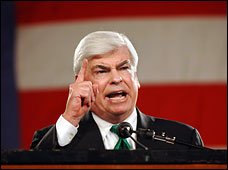
I’m not sure why these things irk me so much. Perhaps it’s because I find descriptive writing very difficult. Pressed to think of a better word than “shock” to describe, say, Christopher Dodd’s hair, I find myself at a loss. Bush of hair? Tuft? Pile? Mass? Bolt? Mane (also clichéd)?
But just because I can’t come up with anything better doesn’t mean I must accept a word that’s just plain wrong. Tarter is not “a plain-spoken woman with a shock of silver hair cut short.” She’s a plain-spoken woman with short silver hair. Is it really so awful to just say so?



 Posts
Posts